


Marketing & Lifestyle
Marketing in the age of distrust


You scroll through an online store, walk into a supermarket, or prepare to sign up for a new service, and suddenly you hesitate. The product seems right, the price is fair, the reviews are positive – yet something feels off. This small moment of doubt has become increasingly common in a world saturated with choices, information, and promises. Behind this hesitation lies a deeper challenge: a growing crisis of trust affecting institutions, companies, and society as a whole. In our book Marketing, A sustainable model for trust building, we explore the origins of this trust crisis and explain how organizations can rebuild trust through responsible and relationship-oriented marketing practices.
The crisis of trust
Trust is eroding at multiple levels of society. First, confidence in institutions has declined significantly. According to the OECD’s 2024 survey, only 39% of people report high or moderately high trust in their national government. This erosion of institutional trust extends to the private sector. While 90% of executives believe customers trust their companies, only 30% of consumers share that view.
The crisis also affects trust between individuals. The 2025 Edelman Trust Barometer highlights growing concerns about unfairness, discrimination, and misinformation, alongside a rising tendency to view others as acting primarily in their own self-interest. As a result, people increasingly place their trust in smaller, familiar circles rather than in broader communities. Today, 7 in 10 individuals worldwide are hesitant or unwilling to trust people who are different from them.
These trends have important social, economic, and political consequences. They fuel polarization, reduce openness to different viewpoints, weaken cooperation, and reinforce preferences for local actors over global ones. Together, they create an environment in which uncertainty extends into everyday decisions, including consumption choices. When trust weakens in institutions, companies, and even interpersonal relationships, individuals naturally become more cautious in how they evaluate information, promises, and risks.
The need for trust
In this uncertain society, the need for restoring trust is higher than ever. Trust functions as a social shortcut, allowing individuals to reduce uncertainty and navigate complexity more efficiently. Trust can be defined as the “expectation that the other party [that could be an institution, a company or a person] will keep its promises and will act in our best interests.” It represents, therefore, a strong belief about the future behavior of someone else. Since it anticipates future outcomes of a relationship, it is also defined as a self-fulfilling prophecy, a strong psychological mechanism stating that their belief leads people to act in ways that make the expected outcome happen. In other words, trust functions as a social shortcut. It allows individuals to reduce uncertainty and navigate complexity more efficiently. If we can restore trust, therefore we will establish a virtuous circle increasing it over and over at all levels of society.
How can we strengthen trust?
Trust is not a fix resource, it can increase and reduce over time. This means that trust does not arise spontaneously, but it is built through identifiable mechanisms. Research and managerial practice converge on several antecedents, that will in turn lead to higher trust and increase its positive outcomes, activating a positive circle.
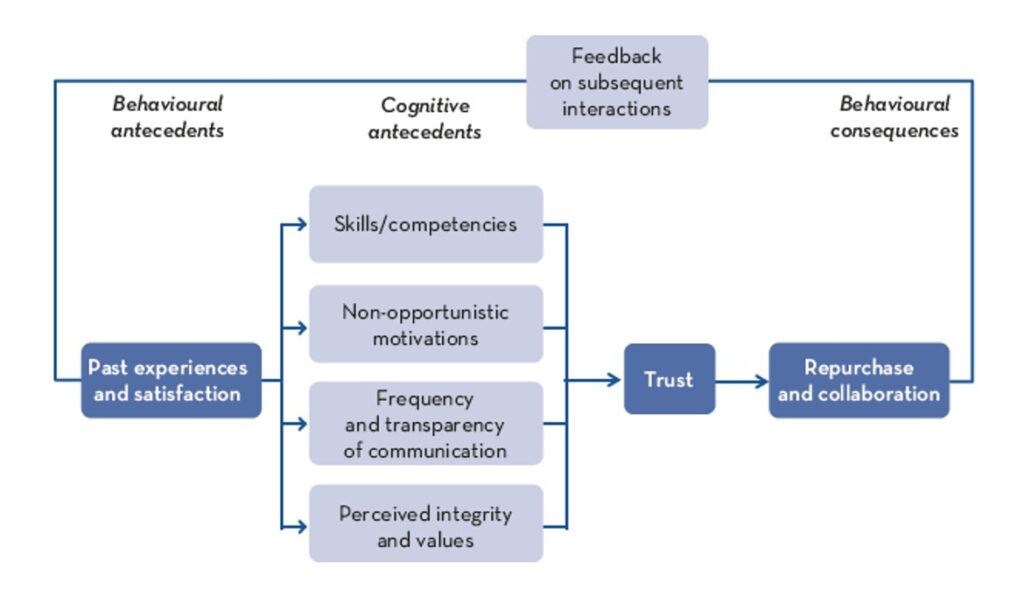
In our book, we applied the trust-enhancing model to companies’ activities (Figure 1), with a specific focus on marketing practices. Specifically, we point out that companies should adapt their practices to contribute to a better society, and we provide examples of some of the most trusted companies that took difficult decisions to this end. This model will help consumers to check if companies are reliable or not and simplify their choices.
First, trust grows from positive past experiences that lead to high levels of satisfaction, making operational excellence and the relationship quality a prerequisite to trust. Second, customers must perceive the company as competent, possessing the skills and resources needed to deliver on its claims. These competencies are usually certified by third parties, and companies display their labels to prove them. Third, trust depends on benevolence, meaning that customers believe the company genuinely seeks their best interests rather than exploiting information asymmetries; trust implies therefore the lack of opportunistic motivation from the company. Fourth, frequent, clear, and transparent communication strengthens trust by reducing ambiguity and making relationships more fluid. If it is easy to maintain transparent communication in good times, it’s more difficult to do the same in uncertain times, when communication is actually more needed. Marketing efforts in communication that is perceived as authentic are therefore key in today’s reality. Finally, trust rests on integrity and values, which give coherence and credibility to the company’s actions over time. Sharing the same values with customers will increase the sense of similarity that is a key component of trust today.
Our book focuses on marketing and how companies can increase it throughout all their marketing policies, but as we’ve seen trust in companies does not operate in isolation. It is part of a reinforcing loop where it strengthens trust in institutions and in people, and in turn, broader societal trust creates positive conditions for companies themselves. So the same antecedents of trust can be used by institutions and individuals to increase trust at the society level.
In the end, the crisis of trust affecting modern society may also contain an opportunity. It is forcing companies and institutions to rediscover a principle too often forgotten in modern capitalism: sustainable success is not built only on sales figures or market share, but on relationships. And relationships, whether economic or human, survive only when trust exists.
In today’s increasingly complex and uncertain world, trust has become a decisive factor, where success will more and more depend on long-term, transparent, and responsible relationship-oriented practices at all levels of our society. Everybody can start behaving to increase trust and to contribute to a better world. Are you ready to contribute?
This article is based on the book:
Grosso, M., Castaldo, S. (2026) “Marketing: A sustainable model for trust building“. Milano, Italy: Bocconi University Press, 296 p.
ISBN/EAN: 9791280623898.