



Strategy & Organizations
Paradoxes at the heart of Ecological Transitions: The importance of Social Justice


When we think of ecological transitions, we can choose to focus on only its positive long-term aspects such as protection of the environment and the wellbeing of future generations. However, this would dangerously distract us from its more problematic short-term social impacts, such as the yellow vest movement in France and the recent European farmer’s revolt.
Why do often good intentioned efforts towards ecological transitions fizzle away, or worse, backfire? It is due to the lack of awareness of contradictions and paradoxes inherent to such transitions.
If there is one statement that everyone agrees on, it is that public and private funds are limited. Hence, tough budgetary choices must be made between competing projects. When transitions fizzle away or backfire, it is millions, maybe even billions, that are wasted instead of being put to more fruitful use. This increases society’s reticence to accept efforts towards an ecological transition, ultimately harming both current and future outlooks of a more resilient and sustainable society.
Let us consider the case of transition to alternative fuel vehicles (AFV) as an illustration of the tensions at the heart of ecological transitions.
Tensions between stakeholders
Car manufacturers, facing an increase in consumer environmental awareness (CEA), have realized that product greening is a sound value proposition. Therefore, they spend significant proportions of their revenues on research and development (R&D). For example, Volkswagen spends more than 5% of its revenue on R&D, with a large proportion dedicated to reducing emissions and developing AFVs. Given these conditions, most car manufacturers offer a range of Internal Combustion Engine Vehicles (ICEVs) and AFVs.
Meanwhile, to address environmental concerns, governments use various mechanisms to encourage firms and consumers to decrease their carbon footprints—including carbon taxes, emissions, and AFV sales thresholds—and consumer subsidies. Stricter environmental regulations are obviously expected to encourage better environmental performance. However, complex trade-offs occur between firms’ profitability and environmental targets. This is challenging for both governments and manufacturers who must accordingly adapt their policies to minimize unintended consequences.
More so, consumers in such a market are heterogenous. They may evaluate similar products differently, directly impacting manufacturers’ R&D investment decisions and the success of government policies.
Complex relationship
The relationship between environmental regulations and firms’ environmental performance is not readily discernable. Some studies have found a positive relationship between the two, claiming that stricter regulations push firms to invest more heavily in R&D and improve their environmental performance. Whereas others have argued that the relationship is subtler, with strict regulations restricting firms’ scope of innovation.
One common point is that effective regulation, i.e. regulation with the appropriate stringency, flexibility and timing, is a key enabler of eco-innovation.
Public policies, including transportation policies, are judged according to both their equity and efficiency. Policies may be more effective if they are targeted toward specific segments of the population: taxes on ICEVs or subsidies enabling relatively wealthy people to purchase or lease AFVs. However, this would clearly be unjust from an equity perspective, bringing us to the concept of just transitions.
Just transitions
Unjust transitions are unsustainable, as proved by the slow AFV transition historically exhibited across nations. A just transition must explicitly consider differing points of view, including the social dimension of the triple bottom line, resulting in a plethora of paradoxes and trade-offs. For example, fuel consumption taxes affect more residents of poorer regions, who have longer average commutes, and banning old, “dirty” vehicles limits the travel choices of low-income groups that rely on these vehicles. Neglecting such trade-offs lowers the willingness of firms and consumers to adhere to ambitious environmental targets. It can even cause a backlash, as evidenced by the 2018 yellow vest movement in France.
More so, the current trend of car ownership is unlikely to change in the near to mid-term future due to technological and cultural lock-in. People are pursuing faster and more convenient travel modes, a phenomenon known as “car dependence”, implying that car ownership is necessary for full participation in society.
Sustainability of the transition
Sustainability rests on three traditional pillars: economic, environmental, and social. Within the social pillar, differing points of views must be considered as previously discussed.
One concept that can assess the impact of regulations and policies on consumers and simultaneously meet equity and efficiency goals while capturing some of their inherent trade-offs is distributive justice. Distributive justice in transportation can be defined as the indiscriminate and equitable access to transportation, with the latter being a vital means for people to realize their full capabilities in society.
In my recent study, the sustainability of the transition towards AFV is investigated. The social pillar is inspired by the concept of distributive justice. The economic pillar is measured via manufacturer profits. And the environmental pillar is measured via the emissions of the vehicles fleet. The three pillars are then combined enabling policymakers to identify trade-offs between the sustainability pillars in a holistic manner. The following diagram summarizes the different elements taken into consideration in the study:
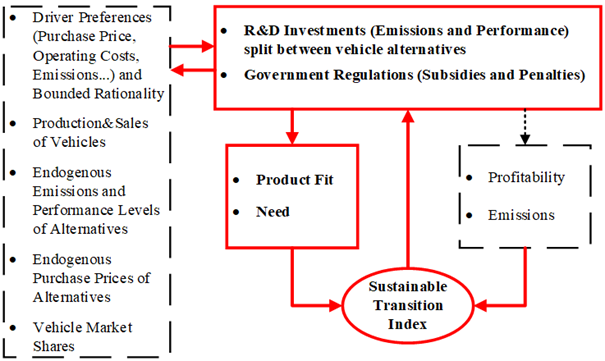
Among the insights derived from the study, are that government regulations ought to be nuanced by focusing simultaneously on:
- Economic dimension: It is the one driving the long-term behavior. To adhere to government regulations and standards and maintain consumer goodwill, manufacturers must adjust and voluntarily increase their R&D spending. In case they do not fulfill their obligations and are subject to penalties, they ought to assume their losses and not shift the burden onto the consumers. By focusing on simply maximizing profits, manufacturers would invest heavily in the subsidized AFVs and relatively neglect the ICEVs. This causes a distributional drift and generates consumer dissatisfaction, resulting in the lowest social performance.
- Social dimension: Solely focusing on improving the social dimension slows down the AFV transition and results in emissions reaching their worst levels by 2035.
- Environmental dimension: When the focus is purely on increasing the AFV market share, AFVs become more attractive to both manufacturers and consumers. Shifting the focus from reducing ICEV emissions to improving AFV performance inevitably results in the manufacturers achieving lower optimal greening levels.
Given the 3-dimensions insights, the environment is better protected when regulations are designed to minimize emissions rather than maximize AFV market share.
Regulations would work best from both the governments and manufacturers perspectives if all three pillars of sustainability were taken into account. Neglecting any one of them systematically leads to worse off behavior. Echoing the degrowth and environmental justice literature, trade-offs are unavoidable between the sustainability pillars.
Academic source: W. E. Hachem, “Interactions Between Manufacturers’ R&D Investment and Government Regulations: The Case of Transition to Alternative Fuel Vehicles”. IEEE Transactions on Engineering Management, vol. 70, no. 3, pp. 1147-1161, March 2023, doi: 10.1109/TEM.2022.3164567.