



Marketing & Lifestyle
Turning the Tables: How Purpose Gives Small Brands the Edge



Think of Victoria’s Secret. For decades the brand stood for one idea of sexiness: ultra-slim models on a glossy runway – until that image stopped fitting the times. The brand tried to switch course and embrace the body-positivity movement with more diverse models, but almost nobody seemed to believe them. Today they are losing customers on two fronts: some miss the old Victoria’s Secret, while others never believed in their body-positivity turn and switched to younger brands like Parade. What looks like a crisis for one giant is in fact a fantastic opportunity for small brands. In our study, we developed a framework that helps small brands turn purpose into a competitive advantage.
Seizing that opportunity means getting one thing right first: the purpose itself. Sustainability, on its own, is often too general and too far removed from people’s actual lives to be truly motivating. The more promising route is to find one overarching goal that acts as a north star for the brand’s social and environmental ambitions: a goal linked to how the people behind the brand want to make their own small contribution to a better world. Finding a brand purpose has a lot to do with finding your purpose in life. That personal purpose can then be transferred to your brand – and can become what deeply motivates you to get up in the morning. So a brand purpose is a central question both personally and strategically: for your life and for your brand.
This is also where size flips from a weakness into a strength. A clear, credible purpose is one of the few levers a small brand can pull against a multinational. The Victoria’s Secret case shows why: large brands carry years of history, established ways of doing business, and a broad customer base. Adopting a new purpose often means changing the business model, which can be slow and expensive, and may also alienate existing customers. Small brands don’t carry that baggage. They have more freedom to adapt their business and focus on customers who share their beliefs. This makes it easier to pursue a clear purpose without trying to please everyone.
What is a brand purpose, really?
Despite all the talk, there is still real confusion about what a purpose actually is – and even more about how to build one. Our research set out to clear this up. The simplest definition: a brand purpose is the higher-order reason a brand exists beyond making money. To qualify, it needs three things. It has to be benevolent, pointing to a cause beyond the company’s or its customers’ own self-interest, for the good of society or the environment. The key is focus, not a scattergun collection of CSR initiatives, but a coherent commitment to one overarching cause or a handful of related issues. And it needs centrality – sitting at the heart of the brand’s identity and actually guiding its decisions.
The best way to understand this is through a few examples that we examined in our research. Biossance frames its purpose as “to encourage people not to compromise animal welfare for beauty products – especially to save the sharks.” Madhappy’s is “to combat mental illness through the power of optimism.” And Indosole’s purpose could be summarized as “To support more responsible consumption by giving discarded tires a second life and keeping them out of landfills.” As these examples show, a purpose often starts with an action verb, such as “to encourage” or “to support,” and should be specific enough to be genuinely motivating.
Six Questions That Reveal Your Purpose
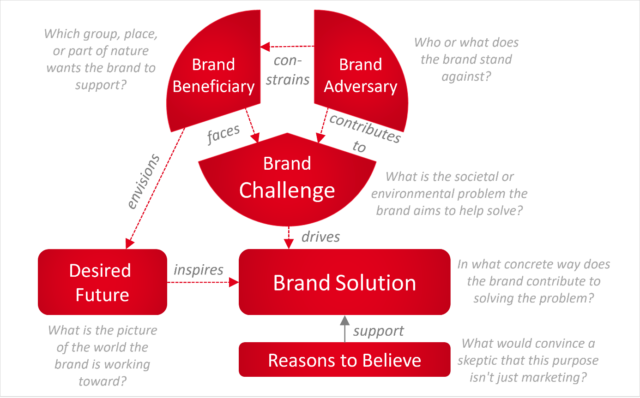
A purpose is just one sentence, but a lot lies beneath it. Our research maps this underlying structure. Looking at these underlying elements helps in two ways: it sharpens the purpose itself, and it gives you the words to communicate it convincingly on your website. Each of the six dimensions can also be turned into a question to ask yourself. Think them through carefully, and a purpose for your brand (and perhaps even for your life) may start to surface. As also shown in the Figure, the six dimensions are:
- Brand Beneficiary: the “for whom” of the purpose: whose life or condition the brand wants to support, whether a social group, a region, or an animal species.
 Which group, place, or part of nature does the brand (or do you) want to support?
Think of Indosole’s dedication to helping the communities and ecosystems in Indonesia affected by discarded tires.
- Brand Challenge: what is going wrong for that beneficiary, and where the brand sees a need to step in.
What is the societal or environmental problem the brand wants to help solve?
Think of sharks being killed for the squalene used in cosmetics.
- Brand Adversary: whoever or whatever sits on the other side of the fight: the force behind the problem, not just the problem itself.
Who or what does the brand stand against?
Think of today’s throwaway culture that still treats used tires and so much else as waste rather than as reusable resources.
- Brand Solution: what the brand actually does about the problem, through its products, projects, or donations.
What role could the brand play in addressing this problem?
Think of Biossance replacing a moisturizing ingredient derived from shark livers with a sugarcane-based alternative, Madhappy using colourful clothing and positive messages to encourage optimism, and Indosole turning discarded tires into soles for new footwear.
- Desired Future: the world the brand wants to wake up in, for the people, animals or places it cares about.
What kind of world does the brand hope to create through its purpose?
Think of oceans in which sharks and marine ecosystems can recover.
- Reasons to Believe: the arguments that convince people the brand can actually pull this off, and that its solution will work.
What would convince a sceptic this isn’t just marketing?
Think of Biossance and Indosole reassuring customers with clear figures: an estimated two million sharks saved each year, and more than 100,000 tires diverted from landfills.
The Golden Rule of Purpose
The three examples show what a strong purpose looks like in practice. The principle behind them is what we’d call the golden rule of purpose: build the product and the business model so that every purchase directly moves the brand one step closer to its cause. And this is precisely where a small brand can out-purpose a giant.
This article is based on the academic publication:
Heine, K., Atwal, G., & Sperber, S. (2026). Turning the Tables: Leveraging Purpose as a Strategic Advantage for SMEs. Strategic Change, 1-11.
http://doi.org/10.1002/jsc.70067