



Strategy & Organizations
2026 Observatory of Transformations: Technology is Back on top of Managers’ Agenda




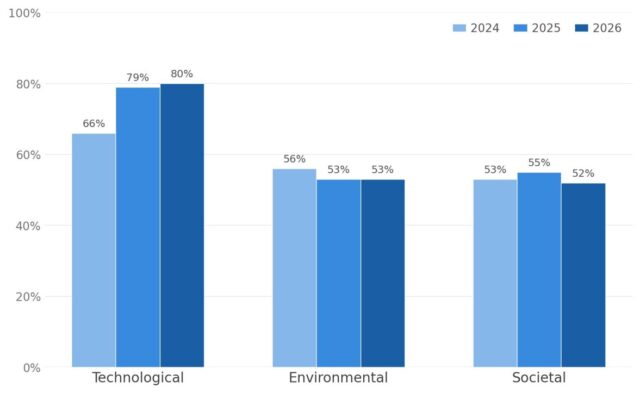
The wave is here, and it is massive: the 2026 edition of emlyon business school’s Observatory of Transformations found that 80% of companies are significantly or completely changing their strategy to integrate technological developments, above all artificial intelligence. This continues the acceleration observed in 2025 and looks striking compared to 2024, when only two in three managers reported changes of such magnitude. By contrast, efforts related to ecological transition are weakening.
The Observatory of Transformations is a pedagogical project that mobilizes the 1,200 students of the emlyon Grande École Program during their first year of the Master’s degree. Each year since 2023, student teams have conducted surveys of managers and company leaders. In early 2026, students collected responses and testimonies from 227 managers. 33% of them held general management positions and 53% sat on executive committees or management boards (1).
Opportunity rather than threat
Managers surveyed increasingly treat technology as a driver of growth rather than a potential threat. They perceive digitization and the introduction of AI as making their businesses “easier” (55%) or even “much easier” (21%) for a total of positive rating of 76% in 2026, five points higher than in 2025. Mid-sized firms appear most receptive to this shift, whereas in prior editions start-ups and smaller firms were more upbeat. In contrast, more than 60% of managers continue to view environmental and societal changes as complicating business operations, in line with previous Observatory findings.
On ecological matters, there are important differences tied to the nature of a company’s activity, notably whether it has a “physical” footprint (manufacturing, transport, retail) or not. Where goods must be processed or moved, managers are acutely aware of changes in the environment—and not just because of regulatory pressure. One executive puts the urgency bluntly: in aerospace, “we must earn our right to continue to exist.” This requires a profound rethinking, for instance, to develop aircrafts that are powered by non-fossil fuels.
At the other end of the spectrum, firms that supply purely intellectual services tend to be more detached. In law firms, audit firms, or web development agencies, managers view the ecological transition from a greater distance. A leader at a major consulting firm admits that his interest has more to do with “pleasing younger workers and thus keeping recruiting” rather than out of personal conviction.
Ecology on the wane
The 2026 Observatory also reveals troubling gaps. Significant strategic changes (“major” or “complete” transformations) related to environmental and societal changes remain on the table for slightly more than half of managers (53% and 52%, respectively), similar to previous years but far below the 80% motivated by technological change.
Strategic shifts reported by respondents primarily affect companies’ relationships with external stakeholders – customers and suppliers first among them. Examples include introducing generative AI into processes to reduce reliance on external providers (notably in marketing) or to automate parts of customer service.
Managers also report organizational changes, namely adjustments to internal relationships. Technology drives significant organizational changes in roughly two out of three firms (64%), whereas environmental matters do so about half as often (33% this year versus 43% in 2024 and 41% in 2025). Changes related to societal issues such as diversity and inclusion are falling in similar proportions.
The paradox of transformations
The Observatory reveals contradictory, even paradoxical, tendencies among business leaders. On the one hand, the ever-faster availability of increasingly powerful technologies is welcomed and quickly exploited, regardless of its immediate financial impact. In short: the more things change; the more companies change. Digitalization and AI look like waves to be ridden in order to avoid being overtaken by a faster, more agile rival.
On the other hand, when it comes to ecological and societal transformations, the pattern is almost the reverse: the more things change, the less companies act. Awareness of shifts in the economic landscape translates into far fewer adaptations. This rigidity sits uncomfortably with basic strategic doctrine, which calls for differentiation to secure competitive advantage (see Michael Porter). Yet the data also reveal exceptions: some firms pursue original strategies – for instance, the CEO of a business-supplies company who claims to make sustainability “the cornerstone of our positioning” and to derive a genuine competitive gain from it.
Double transformation
Beyond the Observatory’s empirical findings, recent research suggests a route to resolving this paradox. Jonas Hammerschmidt and his colleagues propose the idea of a “double transformation” or dual transition. In this model, technology enables firms to become greener, and this ecological awareness in turn accelerates digitalization. Although evidence for such synergy is still scarce, it is a phenomenon that the emlyon Observatory of Transformations will monitor closely next year.
____________________
(1) About the Observatory
As part of the course Technology, Planet, Society: Transformations in Strategizing and Organizing, students in the Grande École Program investigate how major changes affect strategy. Working in teams of five, each group interviews a senior manager about how they perceive shifts in their strategic landscape and how their company has responded. Students collect quantitative data by questionnaire (results summarized here) and conduct an anonymized interview that they analyze. The Observatory now includes several hundred interviews, which are the focus of a separate research project.
Acknowledgements
The authors extend their warm thanks to the students of the Grande École Program (more than 4,000 to date) for their efforts contacting and interviewing executives since 2023. They also express their sincere gratitude to the roughly 800 managers who gave their time to these exchanges, thereby enlightening both students and management research.