


Economics & Finance
Dismantling USAID and the impact on financial inclusion


In recent years, financial inclusion has become a central focus in discussions surrounding sustainable development, as it serves as a catalyst for achieving seven of the seventeen Sustainable Development Goals (SDGs). By fostering economic growth and employment, promoting the economic empowerment of women, and contributing to poverty alleviation, financial inclusion plays a critical role in advancing inclusive and sustainable development. In our research, we have shown the acceleration of digital financial inclusion over the past two decades, especially in African countries. The United States Agency for International Development (USAID) has played a key role in these advances and its dismantling by the Trump administration can regress some of the advances in this field and in many more.
An abrupt halt to growth
Since its establishment in 1961, the USAID has operated in 29 distinct sectors across 158 countries, utilizing less than 1% of the federal budget (based on the latest data available of 2023). USAID has served as a principal donor and a major channel for the provision of development assistance through Official Development Assistance (ODA). ODA programs are specifically designed to promote economic development and enhance welfare in developing nations.
The decision by the Trump administration on February 3, 2025, to dismantle USAID resulted in the termination of approximately 83% of its programs. This measure has had far-reaching consequences, notably impairing global health initiatives such as vaccine distribution and efforts to combat malnutrition in low- and middle-income countries. It has also led to the freeze of the USAID website, where all the information- dashboards, reports and data on the projects – are inaccessible (we were able to extract data through the web of archives). Moreover, it has significantly disrupted financial development projects, which form an essential component of USAID’s broader mission to foster sustained economic growth in these regions. The top 10 beneficiaries of USAID’s funds in 2024 were Ukraine, the Democratic Republic of Congo, Jordan, Ethiopia, West Bank and Gaza, Sudan, Nigeria, Yemen, Afghanistan, and South Sudan. Consequently, the projected growth potential in more than 23 beneficiary countries has declined by no less than 1%.
Financial inclusion initiatives
A significant number of financial development programs are designed to enhance access to safe and affordable financial services – commonly referred to as financial inclusion – for vulnerable populations as well as Micro, Small, and Medium Enterprises (MSMEs). Substantial efforts have been undertaken to promote inclusive finance, leading to notable progress in improving access to appropriate and affordable financial products and services for both individuals and businesses. A broad range of international institutions—including the World Bank Group, the Organisation for Economic Co-operation and Development (OECD), the G20, and Official Development Assistance (ODA) agencies such as the Agence Française de Développement (AFD), Deutsche Gesellschaft für Internationale Zusammenarbeit (GIZ), and USAID—have been actively engaged in supporting financial inclusion initiatives. Additionally, international non-governmental organizations, including the Bill and Melinda Gates Foundation, the Visa Foundation, and the Mastercard Foundation, have played a pivotal role in advancing financial inclusion in developing countries through targeted programs and services.
Our recent findings demonstrate significant progress in the role of digital financial inclusion as a key driver of improved access to financial services over the past two decades.
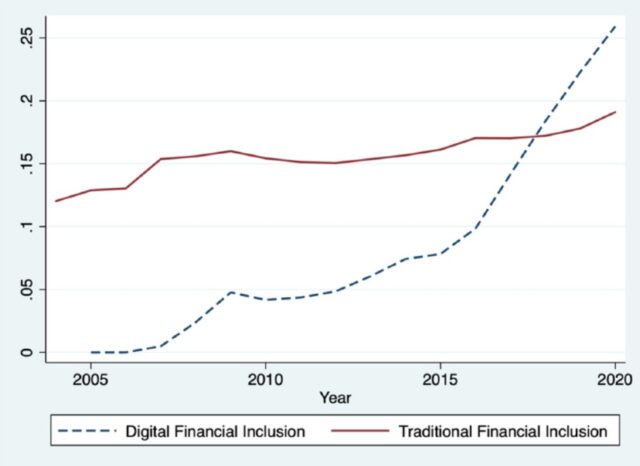
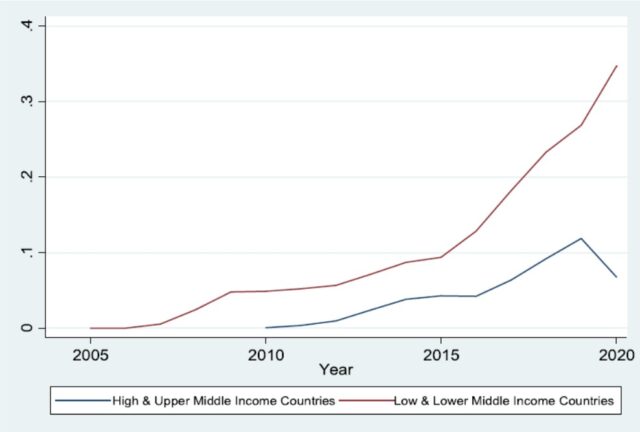
Our results also show that digital financial inclusion, i.e. access to mobile money transfers and digital payments, paves the way for improved access to traditional banking and insurance services in low- and middle-income countries. We also observe massive progress in the recent years for Low- and Middle-income countries in the access to finance through digital financial services such as mobile money accounts and digital payments.
USAID has been a leader in promoting both traditional and digital financial inclusion through numerous programs and initiatives. These projects are typically executed through grants, cooperative agreements, or contracts with thousands of international and U.S.-based development partners. These partners include nonprofit organizations, for-profit contractors, universities, international organizations and foreign governments.
The consequences of USAID’s dismantling
In 2023, 140 USAID operating units around the world allocated funding to Micro, Small, and Medium Enterprises (MSMEs), with a total budget exceeding 366 million USD. These initiatives aimed to support microfinance institutions in extending microloans to rural projects and women-led MSMEs, which typically lack access to traditional banking services.
Furthermore, the agency provided technical assistance to governments in the development and implementation of national financial inclusion strategies. It also supported the creation of a sound, equitable, and well-functioning private financial sector capable of performing essential roles within a market economy. USAID invested in financial literacy through educational programs and training initiatives designed to improve financial decision-making among vulnerable populations.
In addition, the agency prioritized the expansion of inclusive electronic payment systems through high-level advocacy, applied research, and targeted supply-side investments. These efforts contributed to the advancement of digital financial inclusion in several countries by promoting mobile money solutions and reducing dependence on cash for everyday transactions. Digital financial tools supported by USAID have also proven effective in facilitating disaster relief efforts.
Prioritize the resilience and continuity of the programs
The abrupt cessation of USAID operations has had a profound negative impact on partner institutions, disrupting the continuity of numerous effective and operational programs. Many partner organizations were forced to either suspend or substantially scale back their activities because of this decision. This situation underscores the inherent vulnerability of economic development initiatives to shifts in the political agendas of donor countries. The trend of reducing Official Development Assistance (ODA) appears to be gaining momentum, especially following the United Kingdom’s announcement of cuts to its ODA commitments and amid rising economic tensions among developed nations.
Although this decision has faced opposition from numerous American policymakers and may be partially reversed, a full return to a business-as-usual approach appears unlikely. Consequently, the long-term economic sustainability of development-support projects is vital for the achievement of the Sustainable Development Goals (SDGs). Future action plans must prioritize ensuring the resilience and continuity of these programs beyond donor funding, placing this issue on the top of the agenda for both donor and beneficiary stakeholders.
This article is based on the academic paper:
Sha’ban, M.; Ayadi, R.; Forouheshfar, Y.; Challita, S.; Sandri, S. (2024). Digital and traditional financial inclusion: Trends and drivers. Research in International Business and Finance, 72 part B.
DOI: https://doi.org/10.1016/j.ribaf.2024.102528