



Marketing & Lifestyle
Hey Brands, Happiness Is Not Yours to Sell!


Have you ever bought a product because a brand promised it would make you happier? More importantly, can happiness really be bought and sold? While opinions may differ on the first question, many people would strongly reject the idea that happiness is a commodity. Yet marketers regularly suggest otherwise. Brands use slogans such as Nesquik’s “You can’t buy happiness, but you can drink it” and Nutella’s “Spread the Happiness.” Product and brand names such as Happy Socks and Happy Sensation send a similar message: happiness is just one purchase away.
This strategy is far from new. As early as the 1940s, the cigarette brand Lucky Strike targeted young consumers with its slogan “Be Happy – Go Lucky.” Decades later, brands across industries continue to use happiness as a powerful sales tool, often presenting consumption as a pathway to a happier life. But can brands really deliver on that promise?
Happywashing
To better understand this phenomenon and its implications for well-being, we recently published an academic article on the topic with twelve scholars from different universities and our research partner, the World Happiness Foundation. In that article, we define happywashing as “misleading marketing communication practices that exploit the concept of happiness to drive consumption.”
The central argument of our research is that brands sometimes appropriate the concept of happiness and treat it as a commercial tool. By associating products with happiness, marketers can create the impression that consumption is a pathway to well-being. Repeated exposure to such messages may be particularly harmful for young people, who are still in crucial stages of psychological and social development and are therefore more susceptible to these influences.
One consequence is the reinforcement of fear of missing out and materialistic values.
Fear of Missing Out and Materialism
Today’s youth are immersed in digital environments shaped by influencers, aspirational lifestyles, and constant social comparison. In this context, marketing messages that link happiness to consumption can reinforce fear of missing out. The result is a self-perpetuating cycle in which young people feel pressure to keep buying in pursuit of happiness.
The problem is that this pursuit rarely ends. Rather than increasing well-being, repeated encouragement to seek happiness through possessions can foster materialism, a mindset that has long been linked to lower life satisfaction. By framing consumption as a route to happiness, brands may inadvertently make young people more vulnerable to the very unhappiness they promise to alleviate. This illustrates why happywashing matters. Like greenwashing, it can create a gap between what brands promise and the effects their messages may have on consumers’ well-being.
This does not mean that brands play no role in consumer happiness. Many products can create enjoyable moments or positive experiences. But there is a difference between contributing to happiness and selling the idea that happiness can be purchased. It is this distinction that lies at the heart of the happywashing debate.
Happytalism
Questions about whether consumption truly improves well-being are not confined to marketing. They are increasingly shaping wider debates about economic growth, social progress, and quality of life. For example, Serge Latouche argues that economic indicators such as GDP do not necessarily reflect people’s well-being, as shown by the often stark differences between countries’ GDP and happiness rankings. More recently, Luis Gallardo proposed “happytalism” as an alternative paradigm. Rather than linking happiness to greater consumption, happytalism emphasizes well-being, social connection, and institutions that help people thrive. This shift is not limited to academia. The rise of deinfluencing on social media reflects growing consumer skepticism toward the idea that consumption is a sustainable path to happiness.
With this in mind, we developed a framework to help brands design campaigns that genuinely support youth well-being.
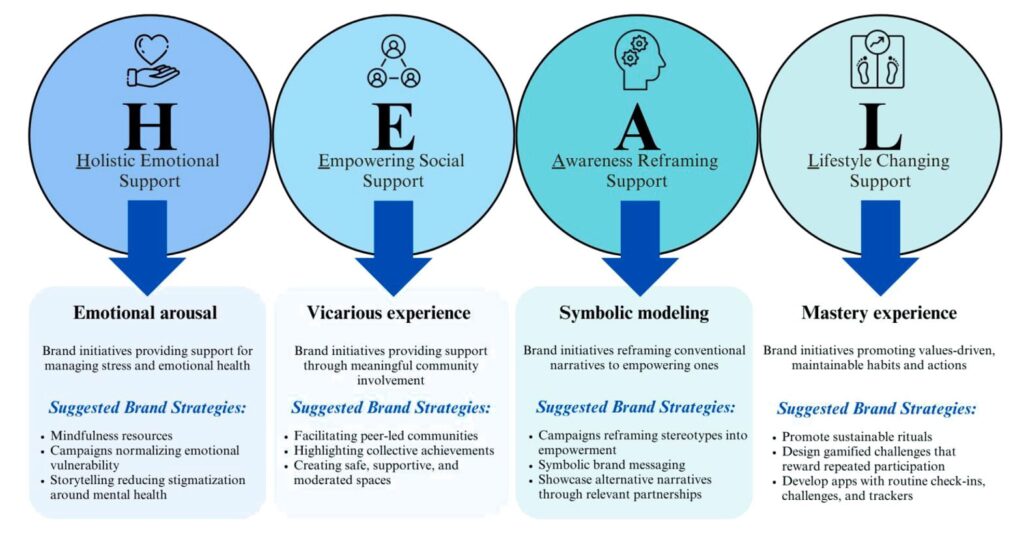
HEAL Framework and Brand Suggestions
To help brands move beyond happywashing, we developed the HEAL framework, a practical approach to supporting young people’s well-being without making it dependent on consumption. Rather than encouraging young people to buy their way to happiness, HEAL focuses on four forms of support: emotional support, social connection, reframing harmful beliefs, and encouraging healthier lifestyles.
Examples already exist. Maybelline’s Brave Together initiative provides mental health resources for young people, Sephora’s Beauty Insider Community creates spaces for connection and self-expression, Always’#LikeAGirl campaign challenged limiting stereotypes, and REI’s #OptOutside encouraged people to spend time outdoors rather than shop on Black Friday. What these initiatives share is a simple principle: they support well-being without making happiness contingent on making a purchase.
Brands cannot solve the youth well-being crisis alone. However, they can stop contributing to it. Policymakers, platforms, educators, parents, and companies all have a role to play in reducing manipulative happiness claims and creating environments that support genuine well-being. Just as regulators have begun to scrutinize misleading environmental claims, happiness-related claims deserve greater attention when they exploit vulnerable young consumers.
At a time when young people are reporting declining levels of happiness and well-being, the challenge is not how to sell happiness more effectively. The real question is how to stop treating happiness as something that can be sold at all.
This article is based on the academic work:
Campos Sousa, E., et al. (2026). From Happywashing to Happytalism: Fostering Youth Well-Being Through the HEAL Framework. Journal of Public Policy & Marketing, forthcoming.
https://doi.org/10.1177/07439156261452981