


Economics & Finance
When the climate upends France’s electricity model


The debate on the energy transition usually focuses on supply: how to decarbonise the electricity we generate. Demand, meanwhile, is being reshaped by climate change itself. As France warms, the question shifts to the when and the where of consumption. Open data from the grid operator RTE and the national weather service Météo-France make it possible to trace this shift region by region, and the picture that emerges is one of profound reconfiguration. Reading that reconfiguration correctly will shape the vast wave of grid investment France is now preparing.
A country wired for winter
In France, electricity consumption responds sharply to swings in temperature. The reason is well known: a large share of homes are heated with electricity. As a result, every drop in the thermometer translates into a rise in demand more pronounced than in most European countries, a phenomenon widely documented by energy economists.
RTE estimates that, in winter, each degree lost adds around 2,400 MW to national demand.
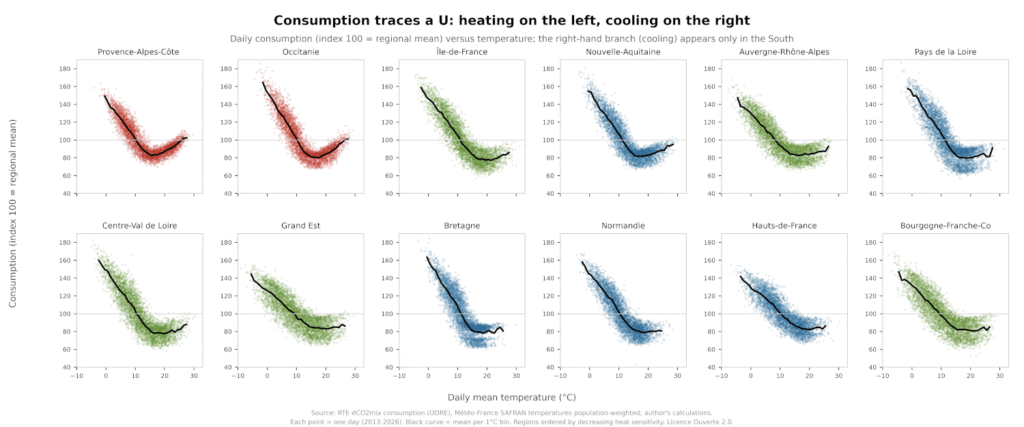
A regional analysis of daily consumption confirms that heating dominates the landscape: the winter response reaches roughly 300 MW per degree in the Paris region alone. Across most of the country, summer is comparatively flat. This is the historical baseline that warming is now changing. The chart below (cf. Fig.1) plots each region’s daily electricity consumption against temperature: the steep left-hand branch is heating, the flatter right-hand branch is cooling. That right-hand branch lifts into a clear U only in the Mediterranean south, illustrating the shift now under way.
A response to heat that splits the country in two
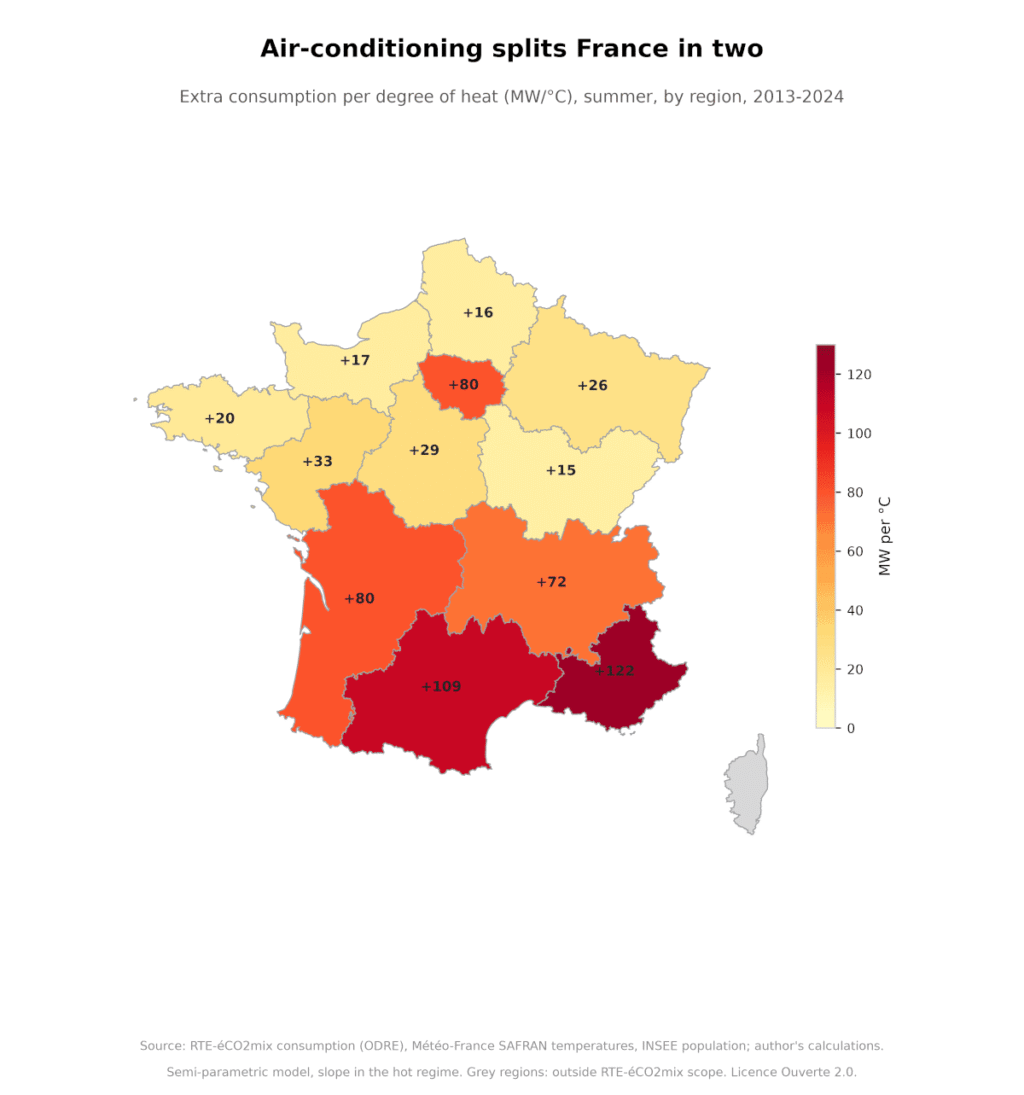
By estimating how consumption responds to temperature, region by region and without imposing a fixed shape on the relationship, a sharp asymmetry emerges. On the cooling side, France splits clearly in two. In Provence-Alpes-Côte d’Azur and Occitanie, hot days raise demand by well over 100 MW per degree. Along the oceanic north and west, the same heat barely registers: in Hauts-de-France the effect is close to 16 MW per degree and is not statistically distinguishable from zero. In terms of electricity demand, winter unites the country. Summer divides it.
Behaviour explains the gap
Warming, on its own, does not create this pressure. The clearest evidence lies in two regions that have warmed almost identically, Auvergne-Rhône-Alpes and Grand Est, by about +1.6°C each. Yet a hot day lifts demand by roughly 72 MW per degree in the former and only 26 in the latter. At comparable levels of warming, only the greater or lesser uptake of air-conditioning can explain that gap.
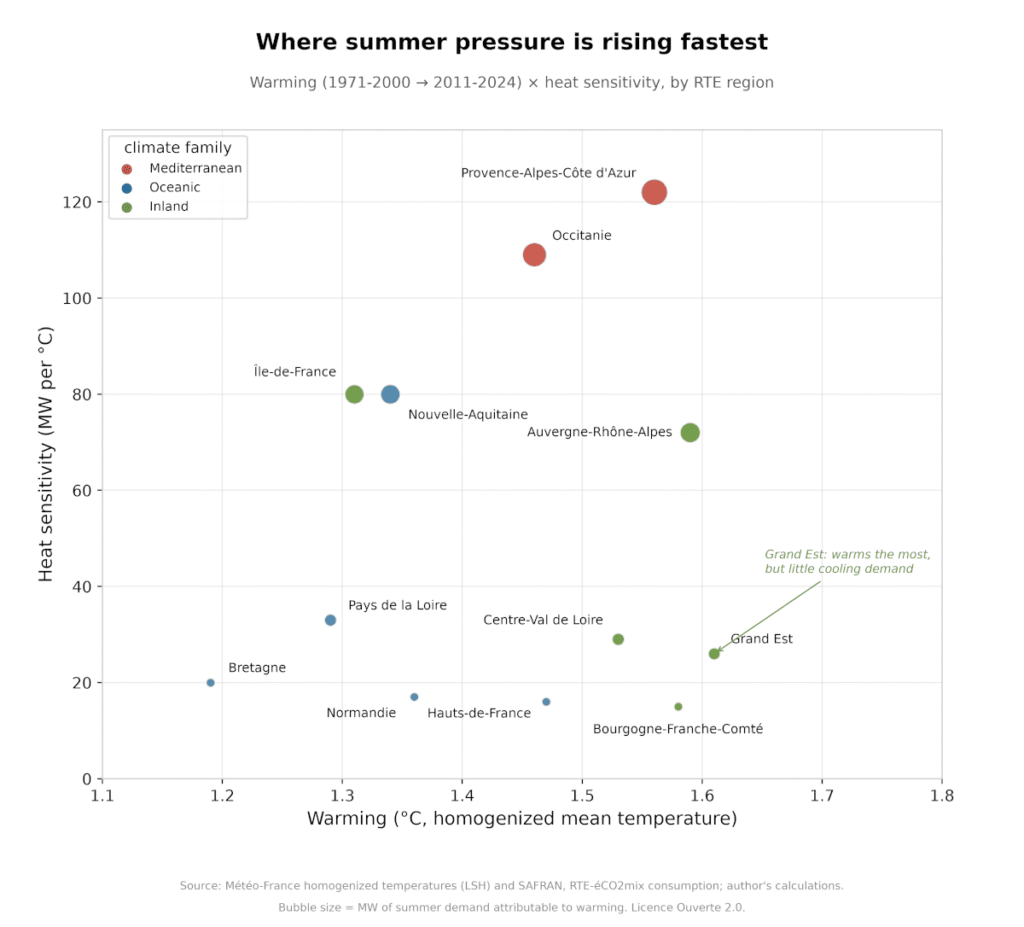
Taken together, a rising summer strain concentrated in the south and a demand curve increasingly shaped by cooling are the first French signs of the north-south polarisation, and the winter-to-summer shift of peak demand, that researchers Wenz, Levermann and Auffhammer projected for Europe.
The signal is not a statistical artefact: its geography matches an independent equipment survey by ADEME, which finds 47% of households equipped in the south-east against 11% in Brittany. The south is the leading edge of a cooling economy that the rest of the country has, so far, largely avoided.
A diffuse cost, price-driven and underestimated
How much does this heat-driven demand cost? The additional volume of demand is meaningful but stable, on the order of 2 to 4 TWh a year. Valued at average electricity prices, the heat-related summer bill runs at roughly 0.2 to 0.8 billion euros a year. The width of that range is telling: it depends far more on the price of electricity in a given year than on any surge in cooling or change in behaviour. In other words, the transformation is not yet an economic shock. This analysis does not, however, account for the changes in demand patterns that the 2026 heatwaves may produce.
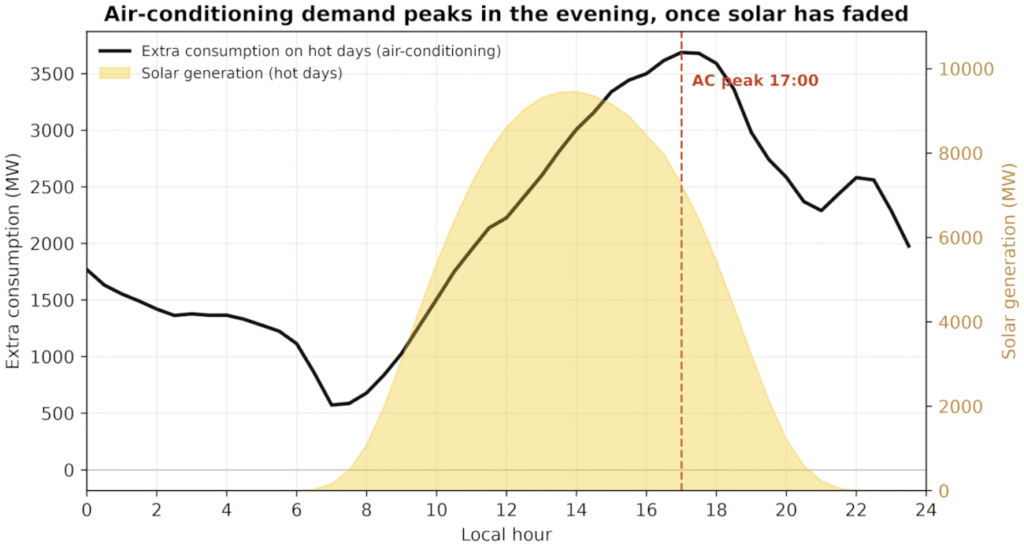
But the energy bill understates the pressure, because the cost of a warming, cooling-driven system falls on peak demand. Cooling demand builds through the afternoon and holds into the early evening, precisely as solar output fades and the system is at its tightest. It is above all the summer consumption peaks, rising steadily, that pull on networks and back-up capacity. A burden whose cost is socialised across all consumers, rather than billed to air-conditioned households alone.
Measured in energy, the shift looks cheap. Measured in peak power, it is where the money will ultimately be spent.
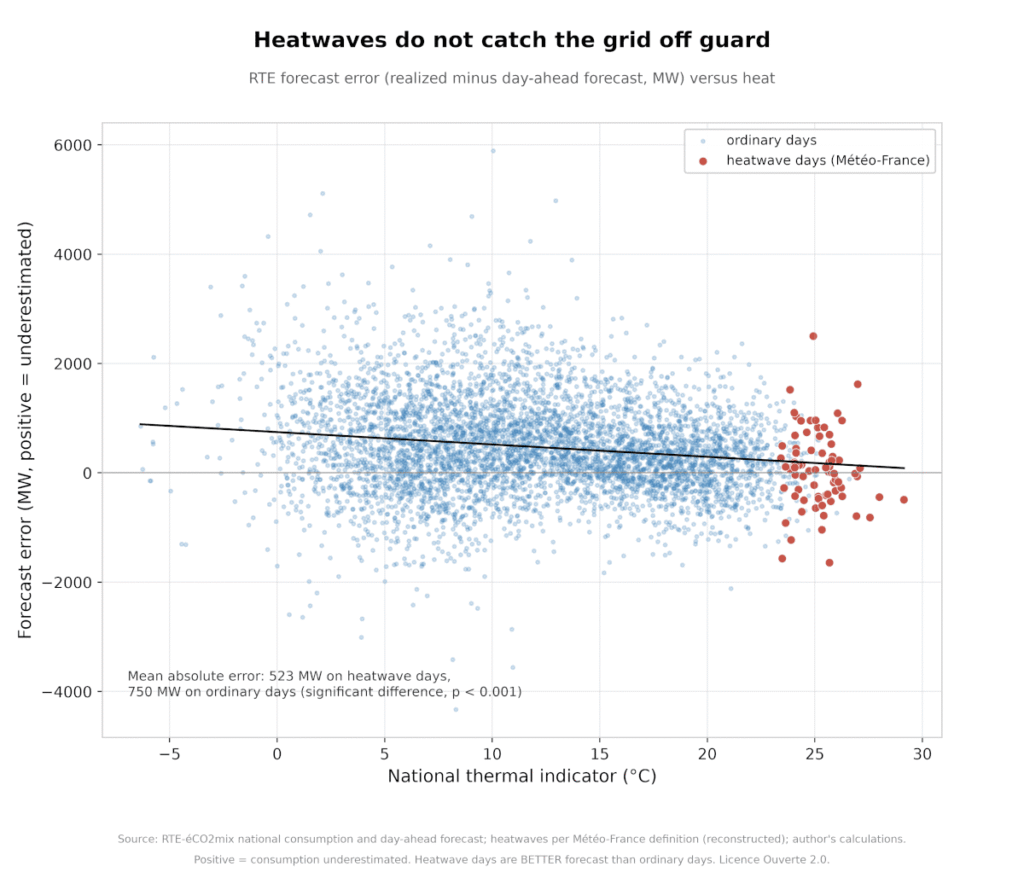
It is also worth dispelling a common intuition. One might expect heatwaves to catch forecasters off guard. The stakes are real: supply and demand must balance on the grid at every instant, and a mismatch of only a few seconds can cascade into a black-out, as Spain experienced in 2025. The data say the opposite. Using Météo-France’s official definition of a heatwave, RTE’s day-ahead forecast error is markedly smaller on heatwave days than on ordinary ones (523 against 750 MW on average). These are among the most anticipated events of the year. Whatever the challenges posed by a grid exposed to a warming climate, unpredictability during heatwaves is not one of them, at least so far and on average.
What this means for the transition
The core insight of this analysis is that climate warming is reshaping the profile of electricity demand in France. Winter demand will ease as the country warms. Summer demand will rise. And the annual peak will slowly migrate across the calendar, pulled by a Mediterranean south that is both warming and equipping itself with air-conditioning. For the grid, what matters is not only how much electricity is demanded, but also where it is consumed. A national figure can therefore mask growing summer strain in the southern regions. With RTE planning a €100bn investment programme to reinforce and modernise the network, reading that shift correctly is central to forward planning.
France’s high-voltage grid was designed to carry nuclear power toward demand centres that peaked in winter. A summer peak concentrating in the south, where solar generation is also booming, changes the direction and timing of power flows and raises the risk of local congestion. Because new lines take time and cost money, the answer is not only to reinforce the grid but also to spread demand more evenly. Shifting some uses away from consumption peaks, through time-of-use pricing, smart control of equipment or storage, can reduce the pressure on infrastructure and defer heavy investment. As summer evenings become the tightest moments for the power system, flexibility acquires a value comparable to that of new capacity.
But the consequences reach well beyond utilities and regulators, into everyday economic life. For a supermarket chain or a cold-storage operator, the cost of keeping goods cold now peaks in July rather than January, above all on the afternoons when wholesale prices climb. For an office landlord in Lyon, a building’s cooling performance is becoming a rent and resale argument, and a poorly insulated tower a stranded asset in the making. The regions bearing the sharpest cooling strain are also France’s tourism heartland, where hotels and restaurants face their heaviest energy bills at their busiest. That same logic will determine where firms site a data centre, how insurers price heat risk, and how fast the heat-pump and retrofit market grows.
The room for manoeuvre exists today: by acting on building standards, energy efficiency and demand management, public authorities can still shape how cooling spreads. Tomorrow, a largely installed stock of equipment risks locking in decades of consumption. To frame the transition through supply alone is to miss a major reality: the climate is already transforming energy demand and the economic balances that rest on it.
This article is a translation of “Quand le climat bouscule le modèle électrique français” by Jean-Baptiste Vaujour, published on Knowledge@emlyon on July 22nd, 2026.
It is based on an analysis of open French data (Météo-France SAFRAN and homogenised series, RTE-éCO2mix, INSEE, Eurostat, ADEME). Key references: Engle, Granger, Rice and Weiss (1986); Bessec and Fouquau (2008); Auffhammer and Mansur (2014); Wenz, Levermann and Auffhammer (2017); RTE annual electricity reports.